
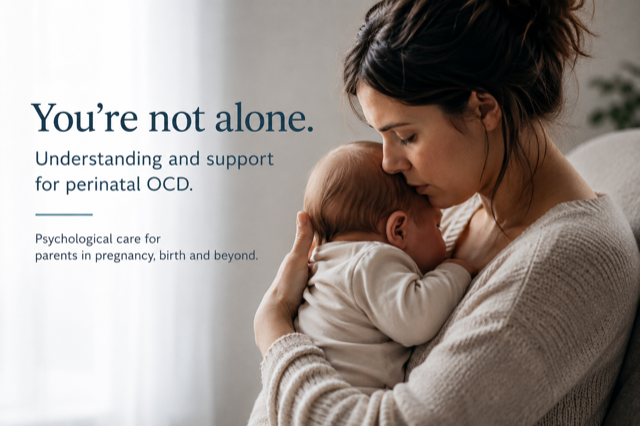
By Eva Gregory, Perinatal Psychologist Many new parents are frightened by unwanted thoughts about harm coming to their baby. They may wonder on repeat:
- “What if my baby does not wake up from their nap?”
- “What happens if I drown my baby?”
- “Why do I imagine dropping my baby?”
Parents may find themselves washing baby bottles over and over again, unable to sleep because they keep checking their baby’s breathing or Googling whether they are going crazy. These experiences often lead to intense shame, fear, and self-doubt, particularly when the thoughts are violent or sexual in nature. Tragically, parents then hold back from telling anyone and seeking help and support. There has been a rising tide of discussion around the mental health of parents in pregnancy and postpartum over recent years, which has led to improved awareness of postnatal (postpartum) depression and anxiety. But depression and anxiety are not the only mental health conditions that can appear during pregnancy and after the birth of a baby. Obsessive-compulsive disorder (OCD) is a mental health condition that has a higher prevalence during pregnancy and postpartum – yet it is often misunderstood and missed by healthcare professionals.
What exactly is perinatal OCD, or postpartum OCD?
Perinatal obsessive-compulsive disorder (also called postpartum OCD when occurring after birth), often involves scary, intrusive and distressing thoughts about harm coming to your baby – either accidental or intentional. Parents often find these thoughts so disturbing they will strive to neutralise or get rid of them through compulsions – which can include either mental rituals or physical actions – designed to prevent the thought from “coming true”. Beyond intrusive thoughts of harm, perinatal OCD can involve obsessions around germs and contamination, compulsive and extensive cleaning, ordering and checking behaviours (such as repeatedly checking on a sleeping baby), and avoidance of triggering situations.
Does having intrusive thoughts mean I will actually harm my baby?
Tragically, because scary, intrusive thoughts are often taboo, involving violence or inappropriate sexual behaviour, parents may fear telling anyone about them. As such, shame and self-doubt grows and thoughts about being a “bad mum” or inherently a terrible person take hold and can overwhelm a parent and delay help-seeking. Although thoughts of infant harm can represent a real safety concern in other mental health conditions (such as postpartum psychosis) – in perinatal OCD there is no evidence they are linked to an increase in risk of harm. In fact, many parents will go to extreme lengths to put in place protective mechanisms, even though these may be nonsensical or actually interfere with caregiving (for example a mum may avoid being in the kitchen because of the presence of sharp objects).
The impact of perinatal OCD on the mother or father can be significant and contribute to self-loathing, a lack of confidence in parenting, withdrawal from friends and family, inability to complete tasks, irritability and depressed mood and impaired attachment between parent and baby. Without proper training, healthcare professionals can sometimes observe these impacts and mis-diagnose OCD as perinatal anxiety and depression. Alternatively, others may erroneously normalise it as being part of an expected shift towards hyper-vigilance often seen in the shift from selfhood to parenthood.
How common is perinatal and postpartum OCD?
Although OCD is experienced by 1-2% of the general population, studies suggest around 7.8% of pregnant women and 16.9% of postpartum women experience perinatal OCD. Furthermore, many more parents may experience some symptoms of OCD without meeting criteria for a full diagnosis. Indeed, research indicates that 80% of parents in pregnancy and postpartum experience scary, intrusive thoughts on occasion.
How do I cope with OCD? Will this get better?
Whether you experience perinatal OCD or simply struggle with an occasional intrusive and distressing thought after having a baby, there is help available. Psychological treatment for OCD is tailored to the condition and can be different to approaches for depression and anxiety – which is why it is important to understand specifically what might be occurring for you. You can have frightening and disturbing thoughts, and still be a great mum or a loving dad. Effective treatment can reduce intrusive thoughts, compulsions, and the constant mental exhaustion that comes with OCD. Eva Gregory has a special interest in supporting parents experiencing perinatal and postpartum OCD, as well as other mental health concerns in pregnancy, birth, and beyond. If you would like to find out more, reach out on 0481 308 742, our friendly intake team will be happy to help you decide whether Eva would be the right Psychologist for you.
Click here to learn more about Evas perinatal services.
Click here to contact Eva.
For immediate telephone counselling and support, or referrals to other services, please contact:
For When: 1300 24 23 22
https://forwhenhelpline.org.au
PANDA: 1300 726 306
https://www.panda.org.au
Pregnancy, birth and baby: 1800 882 436
Lifeline: 13 11 14